






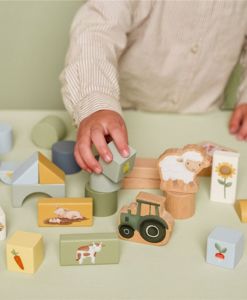
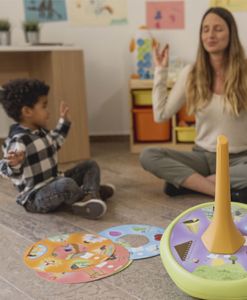

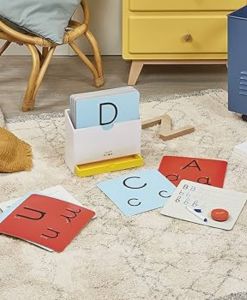
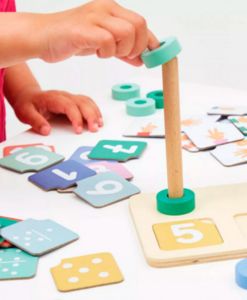

Working in corners means the classroom stops being a place where everyone does the same thing at the same time. Each area has its own material, its own logic and its own pace, and the child chooses where to go and how long to stay.
On paper it sounds straightforward. In practice, the difference between a corner-based classroom that works and one that falls apart by November is almost always the material: it has to explain itself, because the adult cannot be in five places.
Here it is organised by corner:
- Language — photo cards, sequencing, association lotto, rhymes, occupations.
- Reading and writing — sandpaper letters, tracing guides, pre-writing trays.
- Fine motor — Playfoam, tweezers, threading, sorting trays.
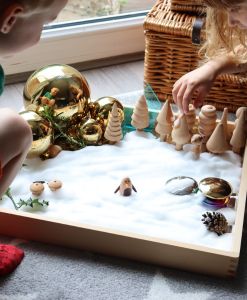
- Multisensory — exploration trays, weight, textures and light.
- Calm and emotional — sensory bottles, photo cards, picture books.
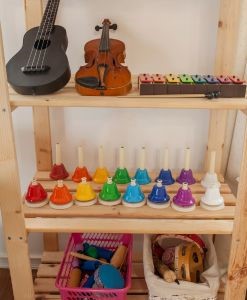
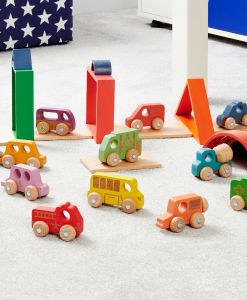
And also, in this section’s menu: art and creativity, construction, symbolic play, logical-mathematical, small worlds, musical and practical life.
The seven corners recognised in early years pedagogy
Worth starting here, because there is a fair amount of confusion about the term. When people talk about learning corners in early years, the reference framework is this:
- Logical-mathematical thinking. Sorting, sequencing, counting, measuring, comparing.
- Communication and language. Vocabulary, narrative, listening, and its continuation into literacy.
- Psychomotor. Gross and fine movement, balance, coordination.
- Art and creative expression. Modelling, free mark-making, music and movement.
- Science and investigation. Mixing, observing, predicting, testing.
- Social and natural world. Animals, plants, occupations, the local environment.
- Symbolic play and role play. The home corner, the shop, dressing up, pretending.
To those seven, many classrooms now add two that do not come from the curriculum but have earned their place: the calm corner, for emotional regulation, and the sensory corner, which began in special education and has spread to mainstream rooms.
Not every classroom has all nine, and none needs to. Four or five at a time is typical, rotating them each term.
What separates corner material from session material
Corner material explains itself. The child picks it up and knows what to do. If an adult has to explain it every time, it is directed-session material.
It has built-in error control. The material itself signals that something is off: the piece does not fit, the texture changes, gaps remain.
It can be graded. It serves the child who is ahead and the one who is struggling, by changing only the instruction or the number of pieces.
It tidies itself. Closed tray, everything inside, a fixed spot on the shelf.
It lasts. Twenty-five pairs of hands, two hundred days. Wood and rigid plastic survive; thin card does not reach Christmas.
Setting up a corner-based classroom without losing your mind
Start with two, not seven. The classic September mistake is building them all at once.
Mark the space properly. A shelf unit turned outwards, a rug, tape on the floor. If a corner is an idea rather than a place, children do not read it as one.
Teach the routine before the content. The first weeks are for practising take it, use it, put it back. It feels like lost time and it is the investment that carries the year.
Put out less than you want to. Four or five options per corner. Abundance paralyses.
Rotate every two or three weeks. Storing and re-introducing beats buying.
Let them mix. The construction blocks end up as food in the home corner, and that is not a mess: it is exactly the kind of play you were after.
Frequently asked questions
What are learning corners?
Bounded areas within the classroom, each with its own material and field of work, which children choose between and rotate through. They replace a single simultaneous activity with small-group work, letting the adult support closely rather than direct the whole class.
How many corners should an early years classroom have?
Four or five active at a time works well in most rooms. Having all seven open usually means none of them is properly resourced. Rotating each term is preferable.
What is the difference between corners and workshops?
A corner is permanent and freely chosen: it stays set up and the child goes when it is their turn or when they want. A workshop is a one-off, has a specific outcome and is usually adult-led, sometimes with families.
What age can you start working in corners?
From age 2 in a very simple form — two or three areas with sensory and manipulative material — and from 3 with the full structure. They still work in primary, though they tend to be organised by subject area.