




The four approaches here agree on one thing: none of them wants a toy that does the work for the child. After that they diverge, quite a lot. Montessori orders, Waldorf suggests, Pikler stays out of the way and Reggio asks questions.
If you are buying and not sure which fits, the comparison below settles it in a minute. And if you already know, here they are:
- Montessori — activity boards, movable alphabet, practical life, sound boxes.
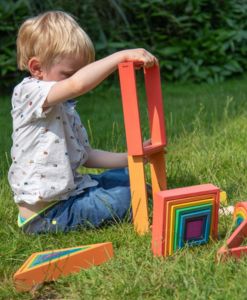
- Waldorf — wooden rainbows, curved balance board, rain stick, bells.
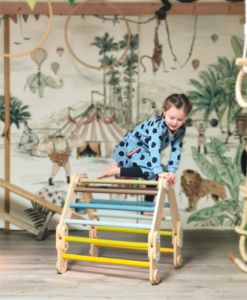
- Pikler — climbing triangle, slide ramp, climbing rocker.
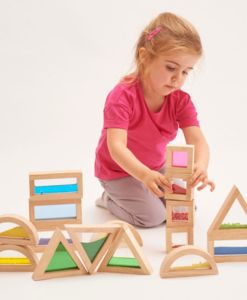
- Reggio Emilia — translucent blocks, treasure basket, magnetic construction, light.
All four, one line each
- Montessori — "help me do it myself". Materials with a specific use and a visible error. The child works alone and knows whether they solved it. Highly structured and grounded in reality.
- Waldorf — "let me imagine it". Simple, unfinished forms, natural materials, warm colours. The less the object defines, the more the child supplies.
- Pikler — "don't lift me". Not tabletop material: movement. The adult prepares the space and never puts the child in a position they cannot reach unaided.
- Reggio — "what if…?". No material of its own, but a way of presenting it. Objects are set out with no instructions and the child is followed wherever they go.
Which to choose, depending on what you're after
If the child tires of everything quickly, Waldorf or Reggio. The problem is almost never the child: toys with a script run out once the script is learned. A rainbow or a set of translucent blocks never runs out because there is no script.
If you want something with a clear goal — the pincer grip, letters, numbers — Montessori. It is the only one of the four that designs material for a specific skill with built-in error control, which is why it dominates in speech and occupational therapy.
If the child needs to move and the house is small, Pikler. A triangle and a ramp solve in two square metres what otherwise becomes the sofa.
If you want talking, asking and explaining, Reggio. The material gives them something to talk about, which is half the job when language is slow to start.
And an observation from seeing plenty of homes: almost nobody sticks to one. The usual and sensible setup is a Pikler triangle, a Waldorf rainbow and two or three Montessori materials, coexisting perfectly well.
What all four share, and why it matters
The child is the one acting. If the toy talks, sings, lights up and congratulates, the child watches. If the toy does nothing, the child does. That is the whole difference between twenty minutes and two years of use.
The material is honest. Wood, metal, cloth, stone. They have weight and temperature and they mark if mistreated. An object with weight informs the hands; lightweight plastic does not.
There is no reward. None of the four uses automatic praise or prizes. The satisfaction is in having managed it, and that is the only kind that doesn't wear out.
Frequently asked questions
What is the difference between Montessori and Waldorf?
The role of fantasy and the degree of structure. Montessori focuses on the real world, with materials that have a defined use and a visible error; Waldorf prioritises imagination, with simple and deliberately ambiguous forms. Montessori is more prescribed, Waldorf freer. They combine perfectly well.
What is the Pikler approach?
An approach developed by Hungarian paediatrician Emmi Pikler based on free movement: the adult does not place a baby in positions they cannot reach unaided, nor teach them to move. They prepare a safe space and observe. The climbing triangle is its best-known piece.
Can you mix approaches at home?
Yes, and most people do. They are not closed systems that contradict each other: they share the underlying idea that the child should be the one acting. A Pikler triangle, a Waldorf rainbow and some Montessori materials sit happily in the same room.
Why do they cost more than an ordinary toy?
Materials and production: solid wood, toy-grade finishes and short production runs, almost always European. It is worth dividing the price by years of use — a rainbow or a triangle gets used from one to six or seven, while a toy with a script lasts a season.