




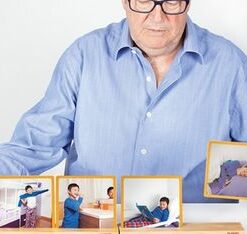
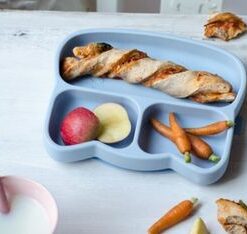

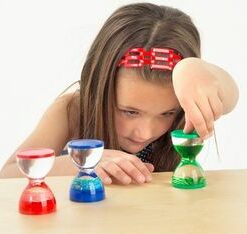
Independence isn’t taught by explaining: it’s achieved by removing obstacles. A thick-handled fork, a plate that doesn’t slide, or a schedule that says what comes next lets someone do for themselves what until yesterday had to be done for them.
This section gathers that kind of material: adaptations that give independence back at the table, in daily routines, in managing time and in learning.
The four sections
Feeding
The largest, with 98 items. Adapted cutlery and cups, plates with rims, non-slip mats, adult clothing protectors. Eating independently is nearly always the first goal that comes up. → See feeding
Basic daily living activities
Dressing, washing, personal hygiene and routine sequences. What occupational therapy calls ADLs. → See daily living activities
Time management
Visual timers, task clocks and organisers. They make visible something abstract that many profiles simply don't perceive. → See time management
Learning with visual supports
Symbols, visual schedules, anticipation material and sequences. The support that lets someone understand what's coming before it happens. → See learning supports
Adapting isn't doing it for them
This is the distinction that decides whether a product helps or gets in the way. A good adaptation lowers the demand just enough for the person to manage it themselves. An excessive one takes the whole task away, and with it the chance to learn.
The rule of thumb: start with the lightest adaptation that works, and withdraw it once it's no longer needed.
For children or adults?
Both, and much of the catalogue is the same. What changes is the design: a child's bib and an adult clothing protector do the same job but must not look alike, because an adult's dignity is part of the goal.
Used in early intervention, intellectual and physical disability, acquired brain injury, Parkinson's and day centres. Profile-specific material under physical disability and ASD.
Frequently asked questions
Who decides which adaptation is needed?
Usually an occupational therapist, sometimes alongside a speech therapist when there's a swallowing difficulty. Buying without assessment works for the basics — a non-slip mat, a thick handle — but not for expensive or specific adaptations.
Do you supply centres with an invoice?
Yes, with an invoice and a quote up front. Send us the list.