










The age on the box is a guide, not a rule. It rules out what is unsafe and little else: two children of the same age can be in very different places.
That said, some things change fairly predictably, which is why organising by age helps:
- 0 – 6 months — looks, listens and mouths everything.
- 6 – 12 months — the pincer grip arrives. In and out, endlessly.
- 1 – 2 years — walking, pointing and first words.
- 2 – 3 years — symbolic play and “me on my own”.
- 3 – 6 years — the hand prepares to write and everything is “why”.
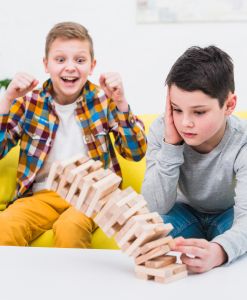
- 6 – 9 years — wants real challenges and can handle losing.
- 9 – 12 years — nothing that looks childish. Fast games and fidget material.
- Family games — the ones that work across all ages at once.
- Also for adults — intergenerational play and therapy use.
How to read the age on the box
Worth knowing what that number actually means, because it is not what most people assume.
The manufacturer's minimum age is mainly a safety marking: below 3 years, small parts that could cause choking are not permitted, and that accounts for most of the "3+" labels you see. It says nothing about whether the toy will interest the child.
Maximum age is not a standard at all — it is marketing. A wooden rainbow labelled "1 to 3" is still used differently at six, and a card game marked "8+" gets played by adults.
The useful criterion is not age but what the child already does. Whether they pinch with two fingers, walk, wait a turn, tolerate losing. That predicts far better whether a toy will land.
What actually changes at each step
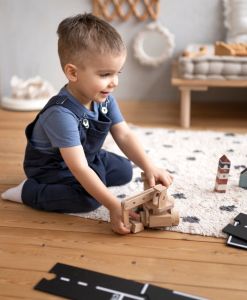
Up to one year. Exploration through mouth and hands. Everything ends up bitten, so safety is nearly the whole criterion.
One to three. Representation appears: one object can stand for another. It is the same mental leap as language, which is why the two travel together.
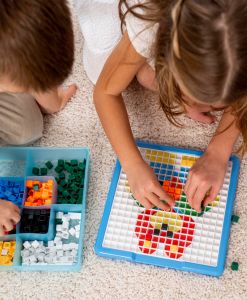
Three to six. Rules appear, and so does a precise hand. Playing with others becomes possible, though losing still stings.
Six onwards. Their own standards appear. They now know whether something looks babyish, and only a real challenge holds them.
Two ways to get it right when you don't know the child
Buy under rather than over. A slightly easy toy still gets played with happily; one that is too hard gets abandoned and leaves the feeling of not having managed. When in doubt, go one band down.
Choose what lasts years. Open-ended material — construction, rainbows, loose parts, cards — gets used one way at two, another at five and another at eight. It works out far cheaper per year than a single-function toy, whatever the box price.
Frequently asked questions
What does the recommended age on a toy mean?
Chiefly a safety marking. The common "3+" indicates small parts that could choke a younger child. It does not indicate whether the toy is developmentally suitable or interesting, and any maximum age shown is advisory and commercial.
How do I choose a toy for a child I don't know well?
Look at what they already do rather than their age: whether they pinch with two fingers, walk, wait turns, tolerate losing. And when in doubt, pick the lower age band — a slightly easy toy is still enjoyed, while one that is too hard gets abandoned.
Which toys last the most years?
Those without a single fixed function: construction, wooden rainbows, loose parts, manipulative material and card games. They get used one way at two and another at eight, so the cost spreads across many years.
Can a child play with toys for older ages?
With supervision and after checking for small parts, yes — and it happens constantly where there are older siblings. What to avoid is the reverse in difficulty: a challenge far above what they can solve produces abandonment, not learning.