




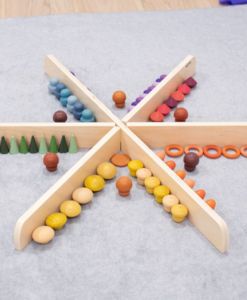
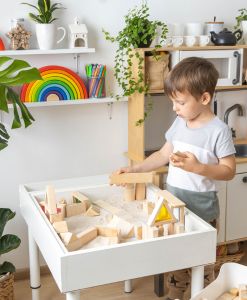
Heuristic play is the play of free exploration: the child investigates, combines and discovers with unstructured materials, with no instructions and no right answer. Touching, stacking, putting in and taking out, comparing… that is how they build knowledge at their own pace, driven by curiosity.
At logopedicum we gather heuristic play materials inspired by Montessori and Pikler: natural loose parts, small worlds to create scenes, and treasure-basket proposals for the youngest. Open-ended, safe and versatile materials, designed for autonomous exploration.
They are part of our games by game type. Explore its two categories to find exactly what you need.
What heuristic play is and why it matters
The term "heuristic play" was coined by Elinor Goldschmied to describe the free exploration of everyday objects and natural materials. Unlike a toy with a single function, heuristic materials don't tell the child what to do: they decide, try and discover. This boosts focus, fine motor skills, divergent thinking and autonomy, and lays the foundations of learning through direct experience.
Heuristic play materials you will find
An open-ended selection to explore:
- Loose parts: natural and wooden elements to combine freely.
- Small worlds: figures and settings to build worlds and tell stories.
- Treasure-basket proposals for the baby's sensory exploration.
- Materials that link to construction and manipulation play.
Heuristic play for home, classroom and therapy
At home, heuristic play offers hours of calm exploration with few materials. In early-years classrooms, it is the basis of exploration corners and non-directed play. And in speech and occupational therapy, it supports attention, manipulation and initiative. The key is the adult's role: prepare the environment and observe, without directing the play.
Frequently asked questions about heuristic play
What is heuristic play?
It is a type of free-exploration play with unstructured materials (loose parts, natural objects, small worlds) in which the child investigates and discovers with no instructions and no predetermined outcome. It boosts autonomy, focus and divergent thinking.
From what age is heuristic play recommended?
It can begin with the treasure basket for babies (from around 6 months, sitting up) and continues with loose parts and small worlds in the 1-6 year stage. Each proposal adapts to the child's moment.
What materials are used in heuristic play?
Everyday objects and natural materials: wooden pieces, rings, fabrics, baskets and figures. The key is that they are open-ended, safe and let the child explore without a single predefined function.