




Wooden treasures
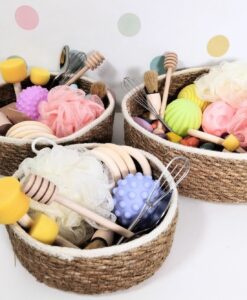
Basket of treasures
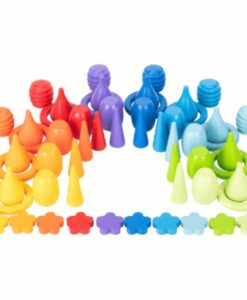
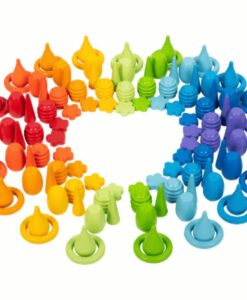
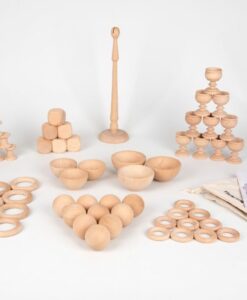
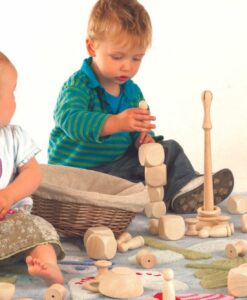
Heuristic game – Wooden set
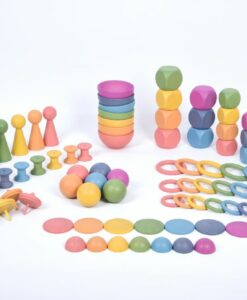
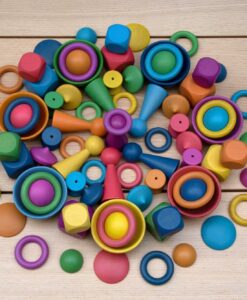
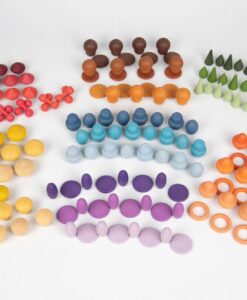
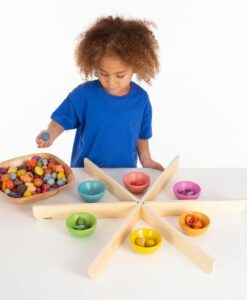
Wooden treasures
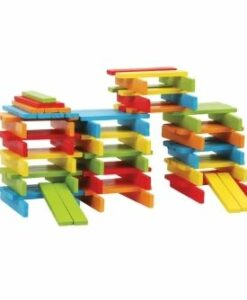
Loose parts are material with no assigned function: rings, discs, bowls, blocks, wooden cylinders. They aren’t anything in particular, which is exactly why they can be anything. Today they’re coins, tomorrow food, the day after the wheels of a truck.
Here you’ll find treasure baskets for the youngest, wooden heuristic play sets and coloured building blocks.
It is part of heuristic play and pairs with small world play.
Loose parts theory, in one sentence
Architect Simon Nicholson set it out in 1971, and it says something very simple: the more variables an environment contains, the richer the creativity and inventiveness of the people using it. A slide has one variable — you slide — and exhausts itself in twenty minutes. A pile of planks, ropes and boxes has infinite ones, and never runs out.
Applied to toys, it explains something every family has seen: the toy that does lots of things entertains briefly, and the cardboard box it came in lasts weeks. A closed toy has already decided what the game is; an open one leaves that decision to the child — and deciding is the interesting part.
The treasure basket: the first open-ended material
Developed by Elinor Goldschmied for babies who can sit but aren't yet mobile, roughly 6 to 12 months. It's a low basket of everyday objects in natural materials — wood, metal, fabric, natural sponge, leather — with one important rule: no plastic and nothing battery-powered.
The reason is sensory. Plastic is always the same: same weight, same temperature, same sound, same texture. Wood, metal and fabric each differ on all four, and that variety is precisely what the baby is exploring.
The adult sits nearby, available, and doesn't intervene: no naming, no directing, no pointing at what to pick up. It's harder than it sounds, and it's what makes it work.
What open-ended material develops
- Divergent thinking. Finding many possible uses for one object — the foundation of creativity.
- Sorting and early maths. Grouping by colour, size or shape, making sequences, comparing quantities. It happens by itself.
- Language. With no assigned name, the child has to explain what each piece is in their game, and that generates a great deal of talk.
- Fine motor skills and balance. Stacking without toppling, fitting, transporting.
- Frustration tolerance. The tower falls, and you start again.
How to present it so it works
Three things make the difference and none cost money. Offer little, well arranged: a tidy tray invites more than a bucket of a hundred pieces. Rotate: put half away and bring it back in a fortnight. And don't suggest: the moment an adult says "why not build a tower?", the game belongs to the adult.
Frequently asked questions about loose parts
What are loose parts in education?
Material with no predetermined function that a child can move, combine and transform freely: wooden pieces, rings, bowls, fabrics, lids, stones. The concept comes from Simon Nicholson's loose parts theory and underpins heuristic play.
What age is it for?
From 6 months with a treasure basket (large objects, always supervised) and with no upper limit: eight-year-olds still use loose parts, just for far more complex constructions.
How many pieces at once?
Fewer than you'd think. To start, 15 to 20 pieces across 3 or 4 types usually works better than a full basket.
Is it safe for babies?
With constant supervision and objects large enough not to fit in the mouth, yes. The practical rule: if it passes through a toilet roll tube, it isn't suitable under 3.