






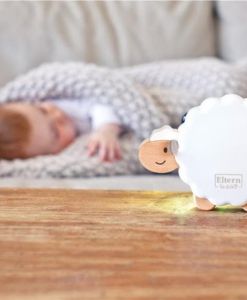
Sleep is learned, and like anything learned it needs the right conditions: a predictable environment, clear signals that night is coming, and something to hold on to when the adult leaves the room. No product solves that on its own, but the right gear makes the journey considerably easier.
In this section we’ve gathered what genuinely plays a part in the bedtime routine, in three blocks:
- Music and night lights — warm dimmable lights, musical lamps, music boxes and clock-lamps for fear of the dark and for knowing when it’s time to get up.
- Comforters and soft toys — attachment objects and soft toys with vibration, warmth or melody that help a child settle themselves.
- Baby books and bedtime stories — sensory, texture and sound books, plus audio storytellers to close the day without screens.
The routine matters more than the product
No object puts a child to sleep. What works is the repeated sequence: the same actions, in the same order, at the same time. A young child's brain doesn't read clocks, but it recognises patterns with remarkable precision, and once the sequence is established, starting it is itself what triggers the sleep response.
A sensible routine runs 20-30 minutes and moves from more active to calmer: bath, pyjamas, low light, story, song, into bed. The products in this section are the anchors of that sequence — the same light, the same soft toy, the same tune — and their value lies precisely in repeating identically every night.
What each stage needs
- 0-6 months. No mature circadian rhythm yet. Constant soft sound, contact and dim light help. Keep the cot clear.
- 6-12 months. Separation anxiety appears. This is comforter territory — always outside the cot until 12 months.
- 1-2 years. The routine consolidates and stories start to make sense. The child wants to take part and choose: letting them pick the book removes a lot of resistance.
- 2-4 years. Fear of the dark and night-time calling arrive. This is the stage for a night light they control and a clock-lamp.
When sleep is harder than usual
In children with autism, ADHD or a highly reactive sensory profile, sleep difficulties are common and aren't solved by boundaries alone: the shift from activity to stillness demands regulation that costs them more. What works particularly well there is extreme predictability — the same order, no variations — and sensory supports the child can seek out themselves: pressure, vibration, constant sound, a minimal steady light.
Worth saying plainly: at logopedicum we sell equipment, not sleep consultancy. If the problem is persistent and affecting family life, the right step is to discuss it with a paediatrician or a professional specialising in child sleep. Our job is to make sure that, once there's a plan, the equipment isn't the obstacle.
Frequently asked questions about child sleep
When do babies start sleeping through the night?
There's no fixed date. Night wakings are normal throughout the first year and fairly common after it. What changes gradually is the ability to resettle alone, and that rests on routine and having a reference object more than on exact age.
Which items actually help the bedtime routine?
The three that repeat every night: a warm dim light the child can control, an attachment object that stays with them, and a story or tune that's always the same to mark the end. You don't need more, and piling on stimulation usually backfires.
Is total darkness better?
For sleep quality, in theory yes. In practice, if total darkness causes fear and the child won't settle or keeps calling out, a minimal warm light is clearly the better option. The key is avoiding white or bluish light and high brightness.
When can a soft toy go in the cot?
Safe sleep guidance is to keep the cot clear for the first 12 months: no soft toys, blankets or bumpers. Before then the comforter is used in arms and while awake, not in the cot during sleep.