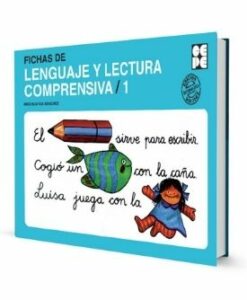
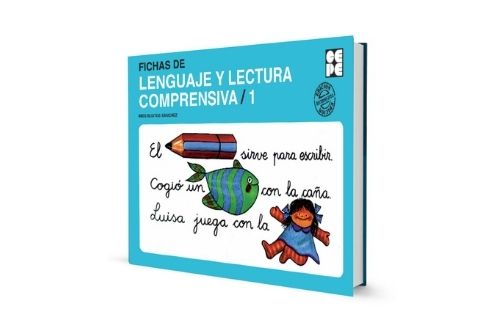

Fichas de Lenguaje y Lectura Comprensiva 1
12,98 € (VAT not included)
School level: 4 to 7 years old.
We offer this compilation of practical exercises of “Lectura comprensiva y lenguaje” that have been applied, for 8 years, with very good results with children with language disorders.
It is not intended with this work to provide a single solution to the problem, but to suggest new ideas that allow to create as many others, adjusting to the specific needs that each case presents. These exercises are an important complement in the reeducation of different language disorders, both for children with normal I.Q. and for borderline or borderline children.
For the application of the exercises it is required that the automatisms of reading and writing are previously acquired and that the children correctly master certain concepts related to space, time and that they have a somewhat developed capacity for linguistic analysis.
| Brand | Cepe |
|---|
In stock
Description
In most cases, the child should never limit himself/herself to working in isolation and in silence; rather, the work will be characterized by a constant oral elaboration of the situations that arise and by the application of all the resources available to the trainer in order to get the most out of each task. One must always be alert to detect those situations in which the child has greater difficulty and be able to determine whether it is strictly a failure to understand what has been read (caused by a possible distraction, by reading too fast, by omitting a word that alters the meaning of the sentence, etc.) or whether the problem lies in the fact that the child has not previously incorporated the concept to which reference is made. For example: if the child has to identify whether the ball is on top, underneath, to the right of the table, etc., and solves it incorrectly, it is possible that he/she has not yet clearly acquired these concepts. In such a situation, work will be backtracked to affirm these spatial notions as the reeducator sees fit.
These exercises can be applied in both individual and group sessions. In the case of group sessions, the speech therapist or teacher will be free to select, adapt or vary the work, according to the average level of learning possibilities of the group of students he/she attends.
Text in Spanish.
Cepe materials for articulation, language and hearing
For articulation, the dyslalia recovery worksheets are an exercise book covering c, r, s and r-clusters for children aged 5 to 8, a classic for correcting speech sound errors. For auditory perception, Mínimo works on minimal pair discrimination, words that differ by a single sound. For vocabulary and morphosyntax, the picture material Verbs. New Vocabulary in Images gives visual support in sessions with children aged 5 to 8.Kits and manuals for professionals
The Logokit series groups materials designed from clinical practice: Logokit 1 covers phonology, logic and morphosyntax, and Logokit 2 covers semantics, pragmatics and morphosyntax. Alongside the kits, Cepe publishes reference manuals on oral language stimulation, bimodal communication, voice and school-based speech therapy.Why buy Cepe at Logopedicum?
Cepe's list is designed for day-to-day work in speech therapy practices, special education classrooms and school guidance teams. Each product page sets out the level and contents. At Logopedicum you can order a large part of the publisher's speech therapy list in one go, with invoices for organisations and terms for professionals.
CONTACTA CON NOSOTROS
Departamento de asesoramiento
[email protected]
Departamento de formación
[email protected]