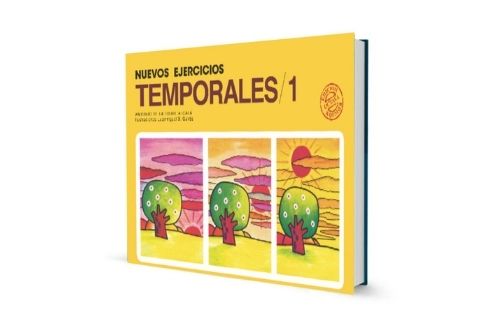
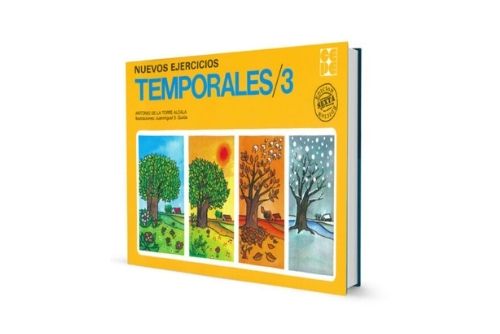
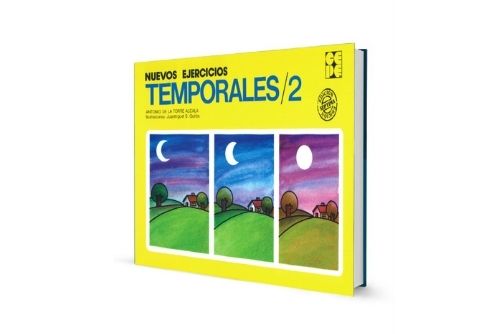



New temporary exercises
13,95 € (VAT not included)
We present in this booklet a series of exercises of ORDINATION OF STORIES, studied in increasing difficulty as a didactic means of great interest for Special Education and Preschool.
In this booklet you will find comic strips from two to four vignettes, so that the child can cut out, arrange and explain chronologically.
It develops what Weschler calls Social Intelligence: comprehension, attention and observation, temporal perception and vocabulary enrichment.
Level 1: from 4 to 6 years old. Level 2: from 6 to 8 years old. Level 3: from 8 to 10 years old.
| Brand | Cepe |
|---|---|
| Level | 1, 2, 3 |
Description
These exercises consist of arranging in a logical way and then explaining stories divided into scenes expressed by an image that will be given to the child separately and out of order. This work will be done gradually in order of increasing difficulty: first with cartoons of only two scenes, taking into account that they should reflect simple and usual things in children and, little by little, they will become more complicated, moving on to those of three, four, five, six, seven and more scenes, as well as more difficult in their meaning.
Finally, and after much use of this material as indicated, and with the greatest tenacity and patience, it will be useful to mix in the same exercise the scenes of two comics, first, and then more comics (starting with the two scenes and then continue with the others), thus forcing the child to make a greater effort, since he/she will have to perform an identification exercise in terms of relating the images of each comic as well as discriminating attention. The purpose of these exercises in general lines could be to strengthen and develop important aspects such as:
- Comprehension in that facts are described that the child will have to understand and interpret.
- Attention and observation, because it will have to capture the small differences between one scene and another to proceed to their arrangement, also identifying in the last exercises the scenes of the same cartoon.
- Spatio-temporal perception, as it forces the child to order the scenes according to their temporal succession, capturing at the same time their chronology and sense of duration.
- Enrichment of vocabulary: given the need for oral expression to explain the meaning of the cartoon, it will require the use of words that will lead to a logical enrichment of vocabulary and in turn will give fluency and fluency in expression.
- In the case of very young children, of low IQ or with language deficiencies, the elements of the small scenes shown to the child will be of great use to the pedagogue or speech therapist as a source for teaching new words.
- Expansion of knowledge: they will be given as “lessons of things” when the cartoon reflects a teaching, as in those that narrate the making of a book, how a house building is made, family life, body hygiene, etc., being able to become, together with other classroom activities on the same topic, a center of interest around which the pedagogical activity of the day could revolve.
Always and in all cases, slowness and patience are recommended when carrying out these exercises, not passing from one stage to another without first consolidating their realization and above all, not asking the child more than he/she can logically give, insisting on the need not to tire him/her in terms of time, preparing him/her so that the next day he/she can take up these exercises again, which should always be presented as a game, with desire, willingness and sympathy. Otherwise, the stimulus of overcoming a difficulty and moving on to the arrangement and explanation of a new story within the pre-established order of increasing difficulty, could become so negative that it leads the child to adopt a closed and discouraged attitude towards the exercise and towards the educator.
Cepe materials for articulation, language and hearing
For articulation, the dyslalia recovery worksheets are an exercise book covering c, r, s and r-clusters for children aged 5 to 8, a classic for correcting speech sound errors. For auditory perception, Mínimo works on minimal pair discrimination, words that differ by a single sound. For vocabulary and morphosyntax, the picture material Verbs. New Vocabulary in Images gives visual support in sessions with children aged 5 to 8.Kits and manuals for professionals
The Logokit series groups materials designed from clinical practice: Logokit 1 covers phonology, logic and morphosyntax, and Logokit 2 covers semantics, pragmatics and morphosyntax. Alongside the kits, Cepe publishes reference manuals on oral language stimulation, bimodal communication, voice and school-based speech therapy.Why buy Cepe at Logopedicum?
Cepe's list is designed for day-to-day work in speech therapy practices, special education classrooms and school guidance teams. Each product page sets out the level and contents. At Logopedicum you can order a large part of the publisher's speech therapy list in one go, with invoices for organisations and terms for professionals.
CONTACTA CON NOSOTROS
Departamento de asesoramiento
[email protected]
Departamento de formación
[email protected]