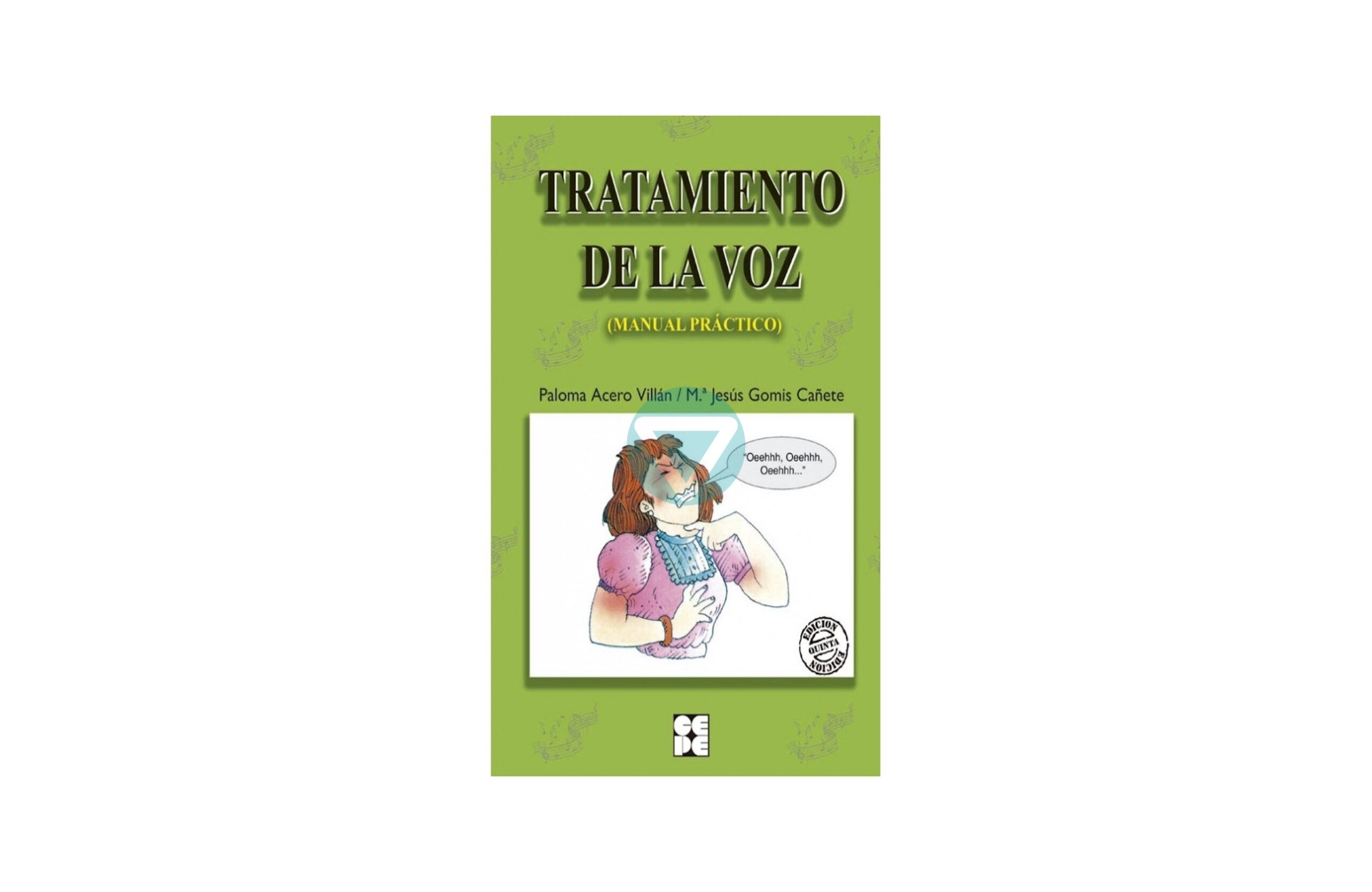
“Tratamiento de la voz: manual práctico”
25,00 € (VAT not included)
| Brand | Cepe |
|---|
In stock
Description
This manual is aimed at voice professionals, speech therapist and voice specialists, in order to facilitate the treatment of vocal disorders. It consists of a series of exercises designed to be applied directly in each of the sessions, both for hypotonia and for hypertonia or functional dysphonia.
Since the aim of vocal treatment is to ensure that the patient is able to produce voice using the maximum of his qualities and with the minimum effort, it is important to make him aware of the need to put into practice what has been exercised in the sessions, in order to generalize, integrate and automate the acquisitions. Therefore, these same exercises are recommended as suitable material for the patient to work on at home in parallel to the treatment and to favor the achievement of a good vocal habit. Experience has shown us that if the patient is able to grasp how the sound is produced and which organs are involved in it, he/she becomes more involved in performing the exercises and progresses more quickly. That is why we recommend that the therapist explain in simple words the process of voice production: how the vocal cords are, where the sound has to pass through, why costo-abdominal breathing is beneficial, etc.
In the case of dysphonia due to vocal hypertonia, in addition to the segmental relaxation proposed in this manual (neck, shoulders, tongue, jaw and soft palate), we also recommend the use of generalized relaxation. The order of execution of the exercises is not random but follows a series of phases successively elaborated in increasing difficulty, although the sequence of application may vary at the therapist’s discretion, depending on the patient’s needs.
Cepe materials for articulation, language and hearing
For articulation, the dyslalia recovery worksheets are an exercise book covering c, r, s and r-clusters for children aged 5 to 8, a classic for correcting speech sound errors. For auditory perception, Mínimo works on minimal pair discrimination, words that differ by a single sound. For vocabulary and morphosyntax, the picture material Verbs. New Vocabulary in Images gives visual support in sessions with children aged 5 to 8.Kits and manuals for professionals
The Logokit series groups materials designed from clinical practice: Logokit 1 covers phonology, logic and morphosyntax, and Logokit 2 covers semantics, pragmatics and morphosyntax. Alongside the kits, Cepe publishes reference manuals on oral language stimulation, bimodal communication, voice and school-based speech therapy.Why buy Cepe at Logopedicum?
Cepe's list is designed for day-to-day work in speech therapy practices, special education classrooms and school guidance teams. Each product page sets out the level and contents. At Logopedicum you can order a large part of the publisher's speech therapy list in one go, with invoices for organisations and terms for professionals.
CONTACTA CON NOSOTROS
Departamento de asesoramiento
[email protected]
Departamento de formación
[email protected]