


Puzzle – Daily Routines
15,70 € (VAT not included)
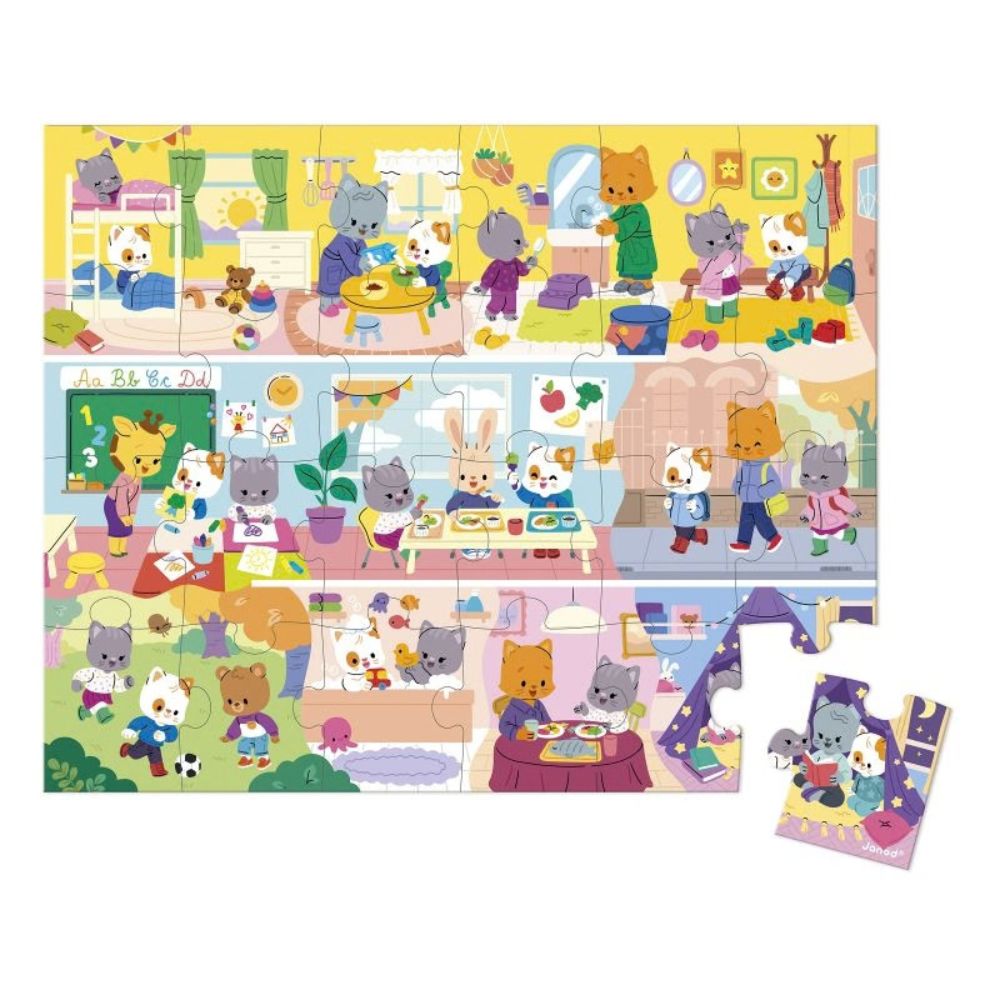
Children’s puzzle about daily routines to help organize the day and explain it
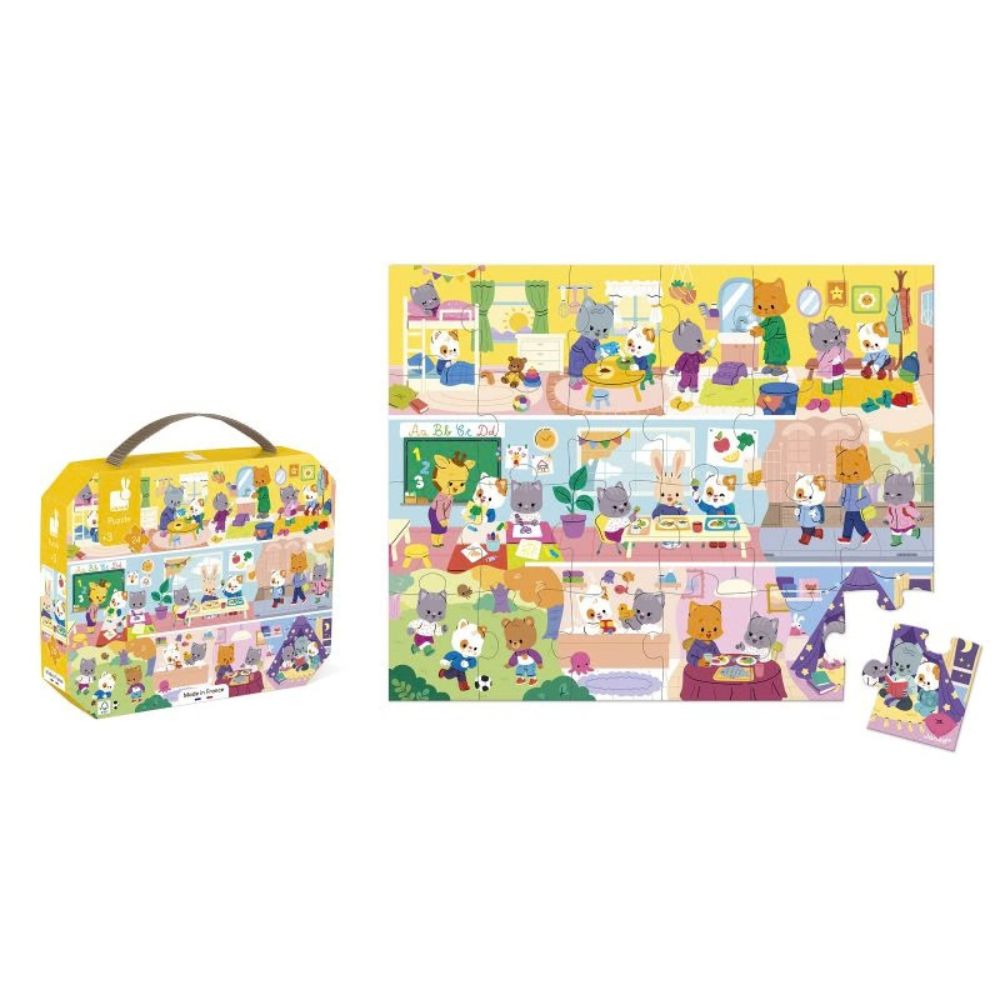
Discover the Daily Routines puzzle, an educational game designed to help children understand everyday activities while having fun putting together a scene full of details. Through the story of the Cat family, little ones will explore everyday moments like waking up, going to school, and eating.
- 24-piece children’s puzzle made of sturdy cardboard
- Illustration of the Cat family and their daily routines
- Includes a guide poster to make assembly easier
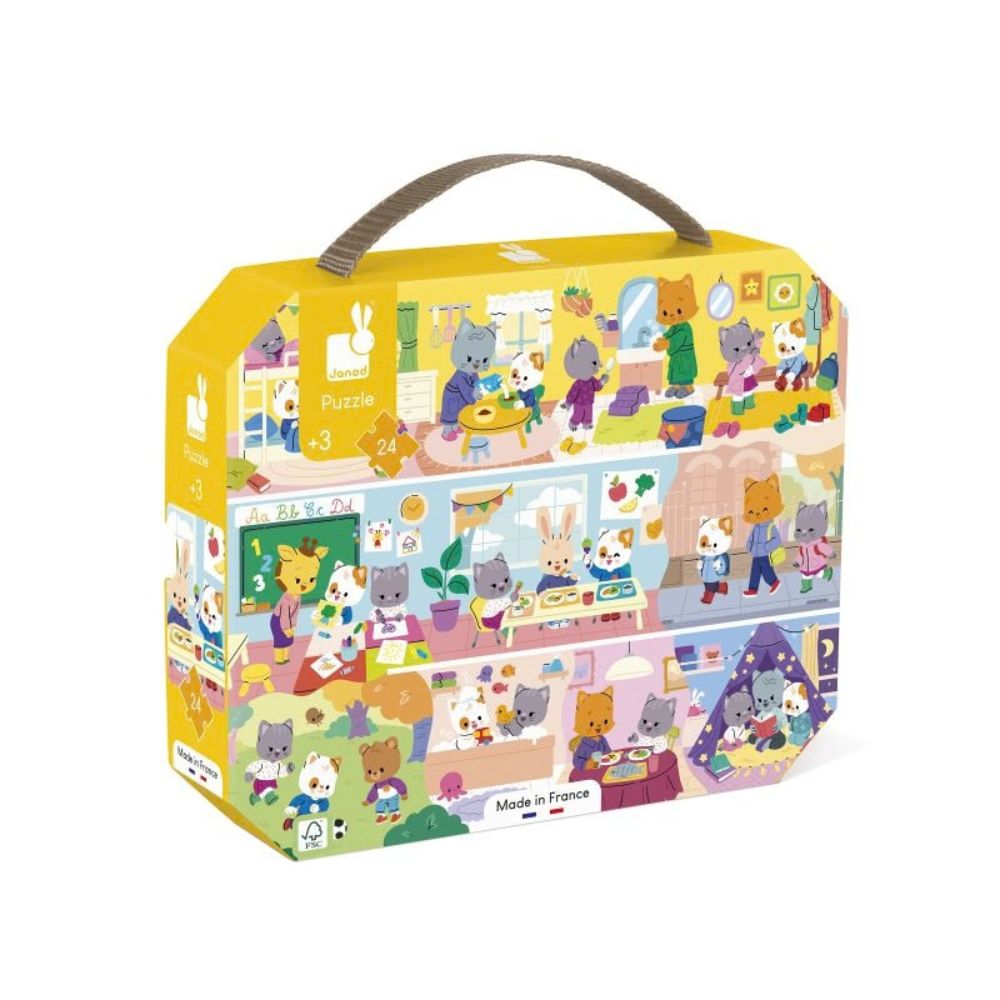
- Comes in a lovely case with a handle, easy to carry and store
- It promotes patience, concentration, and fine motor skills
- Made in France, FSC™-certified, and printed with vegetable-based inks
It is recommended for children aged 3 and up, as the size of the pieces and the difficulty level of the puzzle are designed for this age group.
| Weight | 0,630 kg |
|---|---|
| Dimensions | 5,6 × 27,5 × 22 cm |
| Brand | Janod |
In stock
Description
A daily routines puzzle to help children understand time and daily order and improve language skills
Many children have a hard time understanding the order of the day: waking up, going to school, eating, playing, or going to sleep. But… what if they could learn about it while playing? The Janod Daily Routines Puzzle turns these little activities into an easy-to-understand visual story that’s lots of fun to put together and very interesting to talk about.
With its 24 illustrated pieces, children can recreate the scene of the Cat family going about their day. Each piece reveals details that help young children identify and talk about daily routines.
Why Choose a Daily Routine Puzzle for Kids:
Children’s puzzles aren’t just entertaining—they also help develop important skills. In this case, the daily routines puzzle introduces children to organizing their day while stimulating various areas of development.
Among its main benefits are:
- Improved fine motor skills through handling the pieces
- Development of attention and concentration
- Language stimulation through discussing the scenes in the puzzle
- Understanding daily routines and temporal sequencing
- Promoting patience and problem-solving skills
These types of puzzles are also frequently used in educational and therapeutic settings, as they help children work on the structure of their day in a visual way.
How is it used?
The child can put the puzzle together using the included poster as a guide or try to complete it on their own. As they place each piece, it’s a great time to talk about what’s happening in the scene: who’s getting up, who’s going to school, or what happens during lunch. This way, the puzzle becomes a shared activity that encourages conversation and helps children understand daily routines.
Key features:
This children’s puzzle consists of 24 sturdy cardboard pieces, illustrated with the scene of the Cat family at different times of the day. It also includes a guide poster to help children complete the picture more easily. The entire set comes in a case with a handle, which is convenient for storing the pieces and taking them anywhere. The puzzle is made in France, is FSC™-certified—which guarantees responsible forest management—and uses plant-based inks, which are more environmentally friendly.
It is recommended for children aged 3 and up, as the size of the pieces and the difficulty level of the puzzle are designed for this age group.
Janod toys for reading, writing and listening
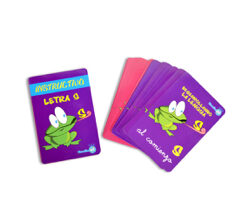
Learning to write – Essentiel is a wooden box with 28 cards: each letter is raised in capitals, lower case and cursive, with the stroke direction, and the back has a dry-erase side for practising with the marker. The Magneti'book Alphabet is a book-style case with magnetic letters (Spanish alphabet) for building words. And the auditory memory game is a memory game where pairs are matched by sound.Sequences and independence
The Sequencing Cards – The Garden set has 40 cards with 10 four-step stories to put in order and retell. The wooden observation tower, from 18 months, has a two-step stool that builds independence and includes a blackboard with 2 chalks and an eraser.Why buy Janod at Logopedicum?
We pick the Janod games that fit language, reading, writing and attention work, so you can order them with the rest of your clinic materials in one go.
CONTACTA CON NOSOTROS
Departamento de asesoramiento
[email protected]
Departamento de formación
[email protected]