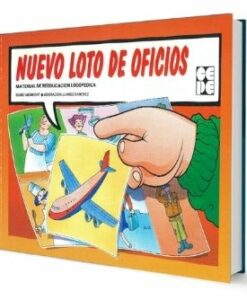
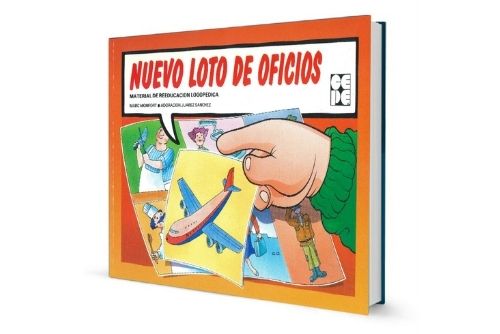

New Lotto of Trades
11,53 € (VAT not included)
School level: 5 to 8 years old.
It contains plates, which include 48 trades among the most common.
Its main objective is the learning and development of a specific lexical category: the trades.
Among the trades included are: Painter. Hairdresser. Dentist. Carpenter. Gardener.
In stock
Description
Language learning normally takes place through communicative interaction between a child and a speaking environment, based on cognitive and physiological skills that determine the pace of development.
This interaction, which is characterized by a reciprocal adaptation of messages and utterances, is sufficient and necessary for the normal development of language to take place to its full extent.
However, there are cases of speech and/or language delays or absences, in which intellectual, sensory, structural or affective deficiencies prevent the full use of these real communication situations which, on the other hand, given the little success they obtain, are often also less stimulated by the environment.
It is then necessary to program a specific intervention, the speech therapy intervention.
Although such intervention should try to catch up as much as possible or correct defects starting from operative situations of communicative interaction (functional strategies), it is often necessary to carry out prior or parallel work of stimulation and specific learning of isolated elements, either in the phonetic aspect, or in the semantic or syntactic aspect (formal strategies).
These specific stimulation or learning exercises, programmed outside communication situations, run the risk of lacking motivation for children and tiring them out because of their highly repetitive nature: this is why re-educators have always made use of a motivation parallel to the learning itself, by including it in a play situation.
The games presented here are only intended to provide speech therapists with training material, long used before in speech and language re-education, focused more directly on those aspects that generally require a more or less long phase of repetition to achieve their definitive acquisition or in which the graphic representation allows a better understanding of the mechanisms that we are trying to re-educate or build.
They are not at all a learning method; neither are they the way to start the presentation of the linguistic contents they use: this presentation must start, in all cases, from an insertion in the communicative chain of which the children themselves are an active part.
They constitute one more material, an aid for a process of stimulation and model setting, necessary in many cases, and each professional will have to interpret and adapt it to his or her own methodological and situational variables.
Cepe materials for articulation, language and hearing
For articulation, the dyslalia recovery worksheets are an exercise book covering c, r, s and r-clusters for children aged 5 to 8, a classic for correcting speech sound errors. For auditory perception, Mínimo works on minimal pair discrimination, words that differ by a single sound. For vocabulary and morphosyntax, the picture material Verbs. New Vocabulary in Images gives visual support in sessions with children aged 5 to 8.Kits and manuals for professionals
The Logokit series groups materials designed from clinical practice: Logokit 1 covers phonology, logic and morphosyntax, and Logokit 2 covers semantics, pragmatics and morphosyntax. Alongside the kits, Cepe publishes reference manuals on oral language stimulation, bimodal communication, voice and school-based speech therapy.Why buy Cepe at Logopedicum?
Cepe's list is designed for day-to-day work in speech therapy practices, special education classrooms and school guidance teams. Each product page sets out the level and contents. At Logopedicum you can order a large part of the publisher's speech therapy list in one go, with invoices for organisations and terms for professionals.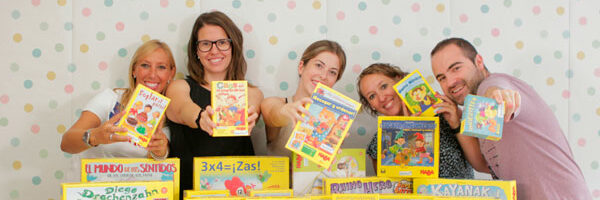
CONTACTA CON NOSOTROS
Departamento de asesoramiento
[email protected]
Departamento de formación
[email protected]