

























Djeco was born in Paris in 1954, when Véronique Michel-Dalès created «les jeux du Djeco»; her designs won four toy «Oscars» in the 1960s. Her son Frédéric relaunched the brand in 1989 and since 1993 it has created its own collections.
Djeco games for thinking, talking and blowing
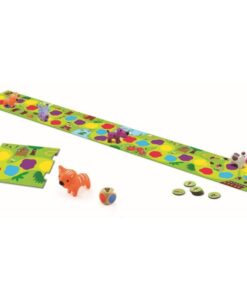
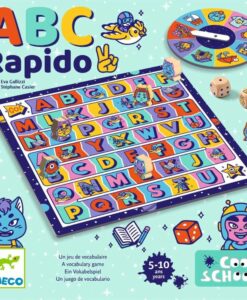
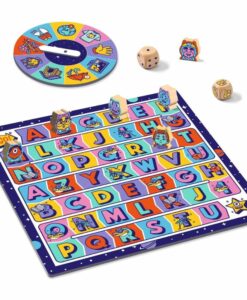
In Topologix children look at where each animal is (on, under, in front of, behind or inside) and place its tile in the grid; turning the card over shows whether they got it right. The ABC Quick Game is a word race with a die and a category spinner, for ages 5 to 10 with 2 levels. And Golfy is a marble minigolf played by hand or, with straws and polystyrene balls, by blowing.
First matching puzzles
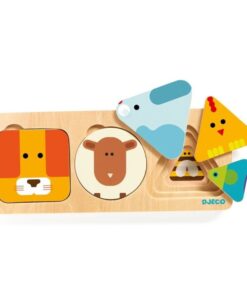
The My Daily Life puzzle has 8 three-piece puzzles in large cardboard pieces for putting everyday activities in order, from age 2. And the Puzzle duo Opposites is 12 two-piece puzzles: only a pair of opposites fits together, so it is self-correcting.
Why buy Djeco at Logopedicum?
We choose the Djeco games that work in therapy and in class (vocabulary, spatial concepts, sequences and blowing), so you can order them with the rest of your speech therapy materials in one go.
Frequently asked questions about Djeco
Where is Djeco from?
Paris: Véronique Michel-Dalès created it in 1954. Her son Frédéric relaunched it in 1989 and it has designed its own collections since 1993.
Which Djeco game works on on, under, in front of and behind?
Topologix: the child places each animal according to where it is and turns the card over to check.
Is there a Djeco game for blowing practice?
Yes, Golfy, a marble minigolf that can also be played by blowing with straws and polystyrene balls.
What vocabulary game does Djeco make?
The ABC Quick Game: a race where you say as many words from a category as the die shows. It is for ages 5 to 10.
Which Djeco puzzles suit the youngest children?
The Puzzle duo Opposites, from 24 months, and the My Daily Life puzzle, from age 2.